Historic England’s New Guidance: Local Heritage Should Not Be a Secret

Most owners know if their house is listed. It is usually there in the estate agent’s details, the solicitor’s report, the mortgage paperwork, and sometimes in the slightly anxious look on a builder’s face when you mention changing the windows.
But Historic England’s new guidance on local heritage listing shines a light on another category of building that many owners and buyers have never properly understood.
The locally listed building. Or, in planning language, a non-designated heritage asset.
It may not be Grade I, Grade II* or Grade II. It may not be on the National Heritage List for England. It may not need Listed Building Consent. But it may still matter. And if it matters locally, owners and buyers need to know about it before they start spending money.
What Historic England’s new guidance is about
In May 2026, Historic England published updated guidance on local heritage listing.
The point of the guidance is not to create a new trap for owners. It is to encourage councils and communities to identify local heritage more clearly, more consistently and more openly. That matters.
For years, many owners have assumed that the position was simple. Either a building was listed, or it was not. Unfortunately, the planning system has never been quite that tidy.
A building can be unlisted in the national sense, but still be recognised by the local council as having local heritage value. It might be an old farmhouse, a Victorian shopfront, a former chapel, a mill building, an estate cottage, a boundary wall, a war memorial, a milestone, a stable block, an old workshop, or a row of houses that gives a street or village its character.
It may not be nationally famous.
It may not be grand.
It may not even look very special at first glance.
But it may help tell the story of a place.
That is what local heritage listing is for.
Not listed. Locally listed.
A locally listed building is not the same as a nationally listed building. It does not automatically require Listed Building Consent. It does not mean the owner has accidentally bought a stately home. It does not mean the council can simply say no to every alteration. But it does mean that the council considers the building, structure, landscape or feature to have local heritage significance.
That significance may come from its age, design, materials, craftsmanship, historic use, group value, townscape value, community value, or connection with local industry, transport, worship, farming, trade or estate life.
In simple terms, it may not be important to the whole country, but it may be important to the place where it stands. That is not a bad idea.
Much of England’s character comes not from castles and cathedrals, but from ordinary buildings made well, used for generations, and quietly doing their job.
The problem is not local heritage.
The problem is hidden local heritage.
Why the new guidance matters to owners
Historic England’s new guidance matters because it pushes local heritage listing in the right direction. A local heritage list should be a useful public record. It should tell owners, buyers, architects, builders, estate agents, communities and planning officers what is considered locally important, where it is, and why it matters. That is how it should work.
Local listing should be a signpost, not a trapdoor.
The difficulty has been that local heritage information has often been scattered. In some areas, local lists are clear and easy to find. In others, the relevant information may be buried in old PDFs, conservation area appraisals, neighbourhood plans, committee papers, Historic Environment Records or internal council documents.
Sometimes the owner only discovers the issue when a planning application is submitted.
That is not good enough.
If a council wants to rely on local heritage value when making a planning decision, the owner should be able to see the evidence. The property should not suddenly acquire special significance at the exact moment the owner wants to make a change.
Heritage is too important to be handled like a secret file.
Local listing does not mean “no”
This is worth saying clearly. Local listing does not mean nothing can change.
It does not create the same controls as national listing. It does not automatically require Listed Building Consent. It does not mean every repair, alteration or improvement will be refused.
But it does mean that where planning permission is needed, the building’s heritage value becomes part of the planning judgement. That can affect extensions, demolition, replacement windows, rooflights, solar panels, external insulation, render, shopfronts, doors, boundary walls, outbuildings and changes to setting. It can affect cost, timescale, design and resale.
The proper question is not:
“Can I get away with it because the building is not listed?”
The better question is:
“What matters about this building, and how do we protect that while making it work for modern life?”
That is a much more useful starting point.
The council should be able to explain itself
If a building is locally important, the council should be able to explain why.
Is it the front elevation?
The windows?
The roofline?
The brickwork?
The setting?
Its former use?
Its connection with a local industry?
Its group value with neighbouring buildings?
Its contribution to the character of a village, street or conservation area?
If the answer is not clear, then the system is not working properly.
Historic England’s guidance is important because it encourages local heritage lists to be better evidenced and more accessible. That should help everyone. It gives councils a stronger basis for decision-making. It gives communities a way to recognise the places they value. It gives owners and buyers a fairer chance to understand what they are dealing with.
A hidden list helps nobody. It creates mistrust. It delays projects. It causes arguments. It makes owners feel ambushed. It makes buyers nervous. It makes heritage look like a punishment rather than a shared responsibility.
What this means if you are buying
If you are buying an older property, do not stop at asking whether it is listed.
Ask whether it is locally listed.
Ask whether it is in a conservation area.
Ask whether it is mentioned in a conservation area appraisal.
Ask whether it appears on the Historic Environment Record.
Ask whether it is identified in the local plan or neighbourhood plan.
Ask whether the council has ever treated it as a non-designated heritage asset.
Ask whether previous planning applications raised heritage concerns.
That may sound like belt and braces. It is. But belts and braces are useful when the trousers are expensive.
The important thing is not to be frightened of local heritage. A locally recognised building may be a wonderful thing to own. But you need to know what you are buying.
A locally important building may need better windows, better repairs, better materials and better design. That can be a pleasure, but it is rarely the cheapest route.
Better to know that before you buy than after you have fallen in love with the arched doorway and the old brickwork.
What this means if you already own one
If your building is locally listed, the first step is to find out why. The significance may be obvious. It might be the whole building, the frontage, the windows, the roofline, the old shopfront, the brickwork, the setting, the boundary wall, or its historic use.
Sometimes the value is not in one dramatic feature. It is in the quiet details: the proportions, the handmade bricks, the joinery, the lime mortar, the old glass, the way the building sits in the street, or the fact that it is one of the last survivors of its type.
Once you know what matters, you can make better decisions.
You may still be able to extend. You may still be able to repair. You may still be able to improve energy performance. You may still be able to replace things that are rotten, damaged or beyond sensible repair. But the work needs to be thought through.
A standard modern solution may not be good enough. A locally important building usually needs a building-specific answer.
The window problem
Windows are often where this becomes painfully real. To one person, a window is just a window. To a heritage building, the windows are often the face, rhythm and character of the whole place.
Change the proportions, the glazing bars, the depth of the frame, the sill, the paint finish, the glass, or the way the window sits in the wall, and the building can lose something that is very hard to get back. This is why local listing matters.
It may not stop replacement windows, but it makes the quality of the replacement much more important. A clumsy window can harm a good building. A carefully made timber window can protect its character for decades.
The same applies to lime mortar, pointing, render, roof details, gutters, doors, ironmongery and external finishes.
The details are not decoration.
They are the building.
A better way to look at Historic England’s guidance
There is a gloomy way to look at all this. You can see local heritage listing as another planning complication, another form, another delay, another person saying no.
Or you can see it as a useful early warning system.It tells you: this building has value. Handle it properly.
That does not mean freezing it in time. Buildings survive because they are used, repaired, adapted and loved. The best heritage work is not about turning houses into museum pieces. It is about making careful changes so the building still feels like itself afterwards.
That is where good owners, good designers and good craftspeople make all the difference.
The real implication of the new guidance
The big change is not that thousands of owners suddenly face a new consent regime.
They do not.
The real change is that local heritage value should become more visible. Councils are being encouraged to be clearer about what is locally important. Lists should be easier to find. The reasons for inclusion should be better explained. Owners and buyers should have a better chance of knowing where they stand before they start spending money.
That is good news, provided the system is fair, public and evidence-based.
It also raises the standard.
If a building is locally recognised, the work done to it needs to be worthy of it.
Our view
At Longnor Heritage, we think Historic England’s new guidance is overdue.
Local heritage should be celebrated, but it should never be hidden.
If a building matters, say so.
If it has local value, explain why.
If the council wants owners to respect that value, the council must be open about it.
A secret local list is not good conservation. It is poor communication.
Good heritage work starts with knowledge. The owner needs to know what they have. The buyer needs to know what they are buying. The builder needs to know what must be protected. The council needs to show its reasoning.
That is the fair way to do it. Because heritage should not be something that appears from behind the curtain when an application goes in.
It should be there in the open, where everyone can see it, understand it, and look after it properly.
Local listing should not be a trap.
It should be a signpost.
It should say: this place matters locally. Find out why before you alter it.
That is not anti-development. It is not anti-improvement. It is not anti-comfort.
It is simply a better starting point.
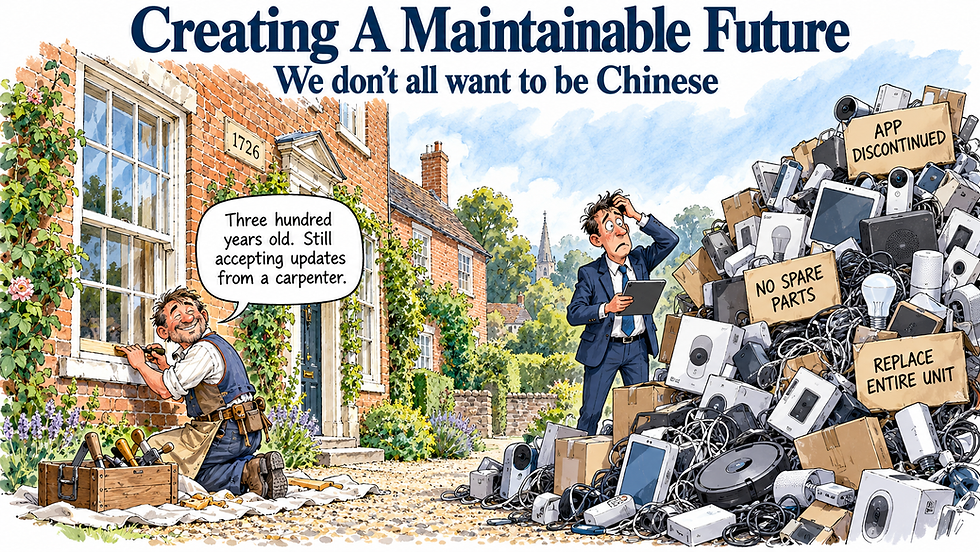
Because if a building has stood for 100, 200 or 300 years, it deserves more than a quick fix from a catalogue. It deserves proper thought, proper materials and proper workmanship.
And if you are lucky enough to own one, that is not just a responsibility. It is part of the pleasure.