Creating A Maintainable Future: We Don't All Want to Be Chinese
Somewhere outside Shanghai there is a place called Thames Town. It has cobbled streets, mock Tudor pubs, a Gothic church, red telephone boxes and, by most accounts, remarkably few people actually living in it. It was built from scratch in a few years as a replica English market town, and couples travel there to have their wedding photographs taken in front of a Britain that never quite existed.
We mention this because Longnor already has the real thing. Our stone was quarried by people who meant it. Our pubs have served actual ale to actual farmers for a very long time. Nobody had to order us from a catalogue. So here is the provocative question: are we going to look after the genuine article, or are we going to turn it, one plastic window at a time, into a slightly damp copy of itself?
The great throwaway
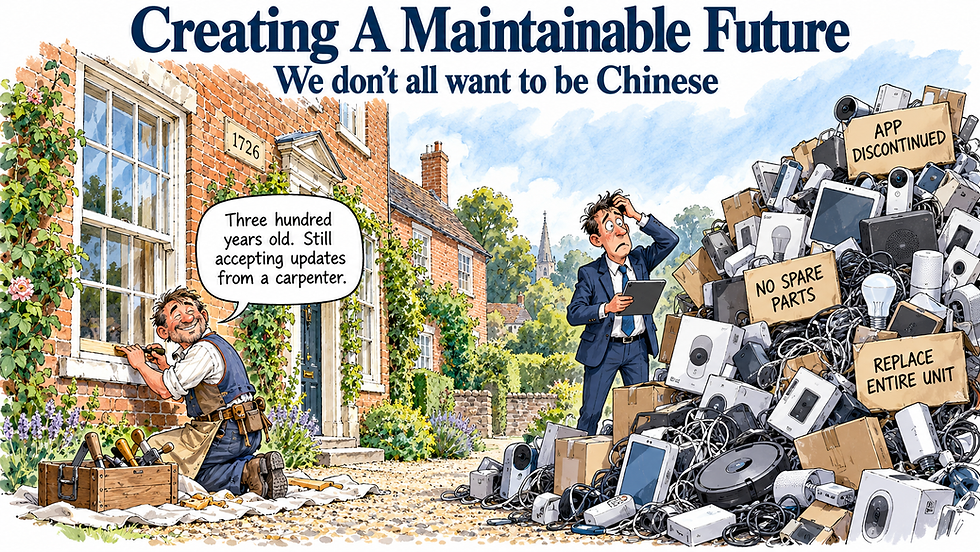
Let us begin in your kitchen. Your grandmother's kettle had a lid, an element and a handle, and when something went wrong a man in a brown coat could fix it with a screwdriver and a cup of tea. Your kettle has a sealed base, a blue light, a chip that sulks if you use it on a Tuesday, and a life expectancy roughly equivalent to that of a hamster. When it dies you do not repair it. You cannot. You put it in the bin, buy another from the same enormous factory on the far side of the planet, and the cycle continues.
This is fine for kettles, more or less. The trouble starts when we apply the same thinking to houses. A building is not a kettle, although some of the windows being fitted around the Peak District would have you believe otherwise.
So why "we don't all want to be Chinese"?
Before anyone reaches for the green ink, let us be clear. This is not a dig at Chinese people, who invented paper, printing, gunpowder, the compass and most of the good bits of the takeaway menu. China has building traditions that make ours look positively youthful, including great timber halls held together without a single nail.
No, our quarrel is with a particular way of doing things that China, for a few decades, did on a truly heroic scale. Knock down the old quarter on Monday. Pour concrete on Tuesday. On Wednesday, bolt on some decorative roof tiles and paint the beams red, and by Friday you have a brand new "ancient" street, complete with souvenir shops. There are towns that have done exactly this, and others that went further and built their own copies of European villages. There is even a replica of the Austrian lakeside village of Hallstatt in southern China, swans and all.
It is very clever. It is very fast. And it is completely missing the point. History is not a look. It is the stuff itself: the worn step, the mended wall, the beam with somebody's initials scratched into it in 1760.
The same philosophy runs the global factory. Make it cheap, make it quick, make a billion of them, and when it breaks make another. We would rather Longnor did not sign up.
The case for being a bit old fashioned
Our ancestors were not sentimental about buildings. They were practical, frequently skint, and had no intention of rebuilding anything if they could possibly avoid it. So they built things that could be patched. Lose a slate, replace a slate. Rot a sill, splice in a new bit of oak. Nothing about a traditional building is sealed for life, which is precisely why so many of them are still standing while plenty of 1970s office blocks have already been flattened.
Here are a few local examples of the old way quietly winning.
Cement: the gift that keeps on taking
Longnor's walls were built with lime mortar, which is soft, breathable and slightly weaker than the stone around it. That sounds like a design flaw. It is actually genius. Water gets in, water gets out, and when something has to give, it is the cheap mortar rather than the expensive stone.
Then, sometime around the middle of the last century, a great many people decided that cement was the future. It was hard! It was modern! It was the building equivalent of a perm! So they raked out the lime and pointed everything in grey concrete. Fifty Moorlands winters later, the water trapped behind that cement has frozen, expanded and blown the faces clean off the stones, while the cement itself sits there smugly, completely unharmed. If you want to see a wall that looks like it has been attacked with a cheese grater, look for one that was "improved" in 1968.
The uPVC window: a hate story
There is a special kind of man who appears on your doorstep with a clipboard and a brochure full of white plastic windows. He will tell you they are maintenance free. He is technically correct, in the sense that you cannot maintain them. When the hinges seize or the double glazing mists up like a bathroom mirror, the only cure is to tear the whole lot out and start again.
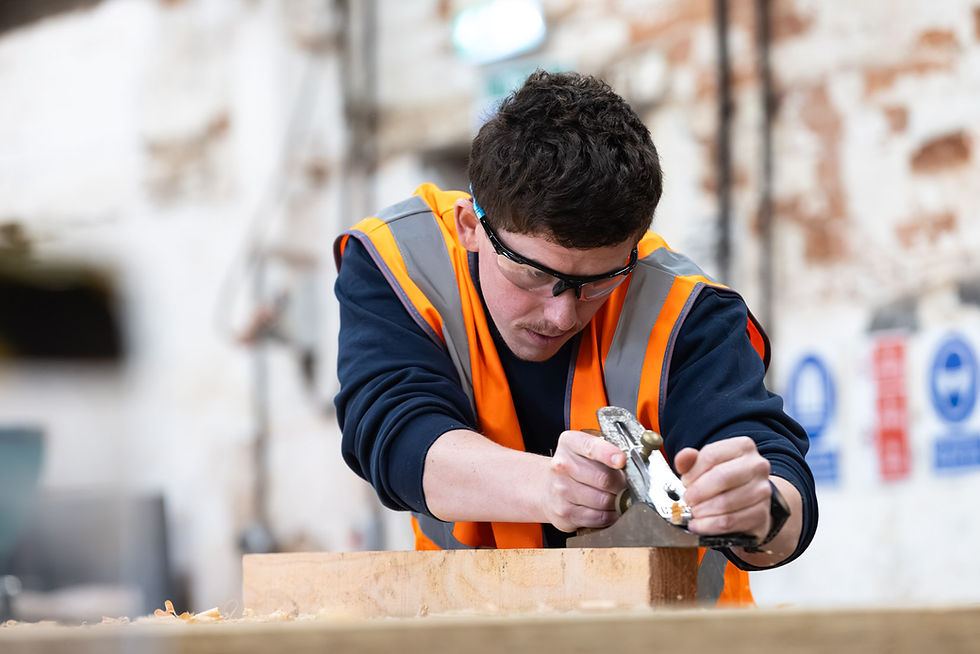
A decent timber sash, on the other hand, can happily last well over a century. When a bit rots, a joiner cuts it out and lets in a new piece. When it needs paint, you paint it. Over the lifespan of one good wooden window you could easily go through four sets of plastic ones, which works out as a rather expensive way of saving money.
And while we are here, no amount of white plastic has ever made a seventeenth century cottage look better. It makes it look like it has had its teeth replaced with Tic Tacs.
Gutters, or the boring bit that saves your house
Cast iron gutters and downpipes can last a hundred years if you keep them painted and clear the leaves out. Plastic ones go brittle, sag, crack and then pour water straight down your wall, which is the one place you specifically did not want it. Nobody has ever written a poem about guttering. Perhaps somebody should, because it is the unsung hero of every old building in the village.
Stone slate roofs
The great gritstone roofs around Longnor were laid with the biggest, heaviest slates at the bottom and the smallest at the ridge, and they can last for generations. When the time comes, a good roofer strips them, sorts them, tops them up with reclaimed stone, and puts most of the originals straight back on. People now give conferences about the circular economy as if they had just thought of it. Our roofers were doing it when Victoria was on the throne.
The drystone wall: the original flat pack
The finest example of all is out in the fields. A drystone wall has no mortar, no fixings and no instructions in four languages. When a stretch falls down after a hard winter or a reversing tractor, the waller picks up the same stones and puts them back. Some of those stones have been rebuilt so many times they probably have opinions. Compare that with a flat pack wardrobe, which can just about survive being assembled once and dies of shock the first time you move house.
"But repair is so expensive"
Is it, though? Repair can look expensive on the day, mostly because it is being compared with something designed to be replaced again in fifteen years. Measure the cost over fifty years and the sums look very different.
A blocked gutter cleared in October costs you an hour on a ladder and some mild swearing. The same gutter ignored for three winters can deliver soaking walls, rotten joists, crumbling plaster and a bill large enough to make your eyes water. The conservation bodies have been preaching "little and often" for over a century. It is not glamorous advice, but neither is a dry rot survey.
There is a local angle too. Pay a joiner, a waller or a stonemason and the money mostly stays within a few miles of the village. Pay for a container of mass produced replacement parts and it heads off over the horizon, never to be seen again.
Use it or lose it
Traditional craft skills are not dead, but they are not exactly thriving either. Every time someone chooses a lime plasterer over a man with a staple gun and a sheet of plasterboard, they keep a trade alive. We would love to see more young people round here taking up walling, roofing and joinery. It is skilled work, it is outdoors, and you will never be outsourced. Nobody has yet worked out how to ship a drystone wall across the world in a box.
Long live the real thing
Longnor is not a film set, and it should never become a heritage themed retail experience with genuine imitation character. It is a working village that has been patched, propped, mended and argued over by its residents for centuries. That is exactly what makes it worth visiting, and worth living in.
Somewhere on the other side of the world, people are paying good money to pose in front of a copy of an English market town. We have the original, and all it asks of us is a ladder, a bit of lime and the occasional Saturday afternoon. Let us not wait until someone has to build a replica of it.